Many entrepreneurs look at what their competitors are doing, copy it half-heartedly, and then wonder why they aren't growing. The irony is that a good digital competitor analysis actually teaches you where your competitors are absent, which opportunities remain untapped, and where you can make a difference with your own approach. Beating online competitors is not done by chasing after them, but by finding the gaps in their strategy and filling them with your unique positioning. This article explains step-by-step how to approach this, what tools you need, and how to go from insight to action.
Table of Contents
- Quick Insights
- What is a digital competitor analysis?
- How do you map out your competitors?
- The right tools for your analysis
- From analysis to unique positioning
- Frequently Asked Questions
- Sources
Quick Insights
Key Insight · Explanation
Analyze behavior, not just offerings — Look at how competitors position themselves, communicate, and maintain visibility, not just what they sell.
Look for gaps, not inspiration — The power of competitor analysis lies in what competitors don't do: the space that you can claim.
Use the four Ps as a guide — Product, Price, Promotion, and Place provide a structured overview of the competitive landscape.
Keyword gap analysis reveals SEO opportunities — With tools like Semrush or Ahrefs, you can see which keywords competitors rank for that you are not yet targeting.
Brand positioning is more than a logo — Customers choose the brand that comes to mind most clearly as the solution to their specific problem.
Repeat the analysis regularly — In fast-changing markets, a quarterly analysis is wise; for more stable markets, an annual review is sufficient.
Positioning only works when it is credible — Being distinctive is different from wanting to be unique. Build on real strengths that customers recognize.
What is a digital competitor analysis?
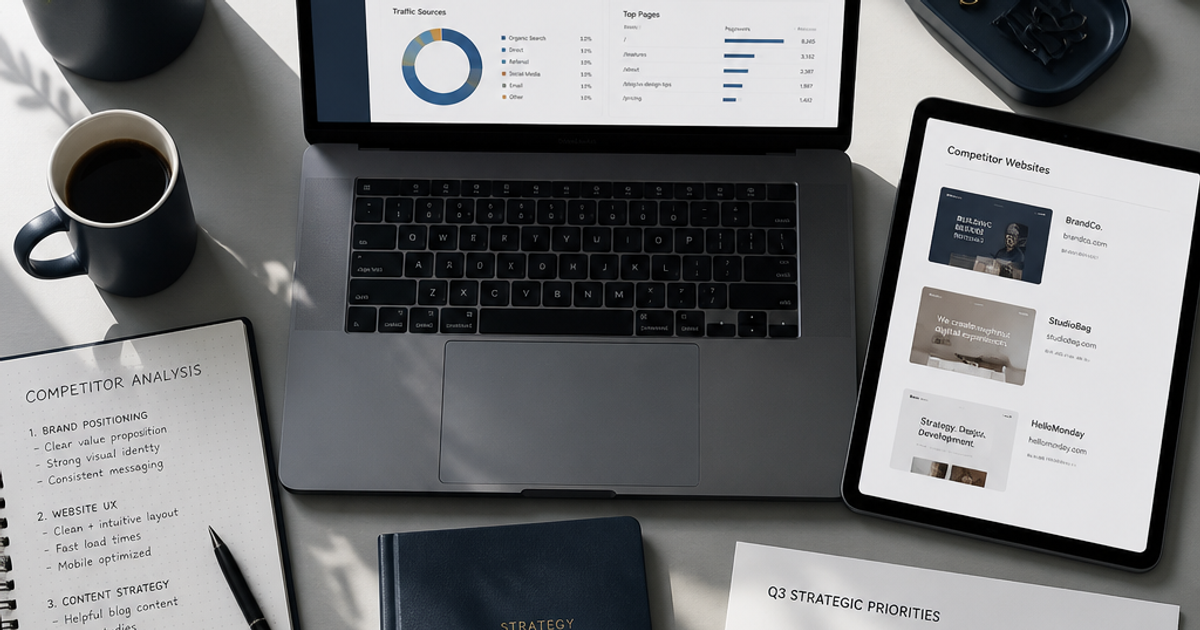
A digital competitor analysis maps out how your direct and indirect competitors behave in the market. Not only regarding their offering, but also their visibility, positioning, pricing strategy, communication, and content. This way, you discover where you can win, instead of copying.
There is a big difference between a superficial glance at a competitor's website and a true analysis. Those who only look at design or copy miss the essence. A thorough analysis examines competitors' strengths and weaknesses, but also their blind spots, the opportunities they miss, and the market segments they do not serve.
For a Belgian SME or entrepreneur looking to grow online, this is not a luxury exercise. It is the foundation of any smart marketing strategy. Without this insight, you invest budget into campaigns that three others are already running, and wonder afterward why it didn't work.

How do you map out your competitors?
The first step is identifying your direct and indirect competitors. Direct competitors offer the same product or service to the same target audience. Indirect competitors solve the same problem through a different approach. Both are relevant to your analysis, but for different reasons.
Direct versus indirect competitors
A web design agency in Belgium has direct competitors, such as other agencies offering the same services. But real competition also comes from freelancers, foreign platforms, or even DIY website builders like Wix or Squarespace. If you ignore that second category, you miss a large part of your actual market position.
In practice, you start with a simple Google search for your primary keywords. Who appears at the top? Which advertisers are active? Note down the top five to ten results and use them as a starting point for your analysis.
What to examine for each competitor
Use the four Ps as a guide: Product (what they offer and their unique selling points), Price (how they position themselves on price), Promotion (which channels and messaging they use), and Place (through which channels they reach their customers). A complete analysis also includes information on company size, customer reviews, social media presence, and the quality of their website content.
Tip: Save your findings in a structured spreadsheet per competitor. Record not only what they do, but also how effectively they execute it and whether it works. A competitor might be active on Instagram, but if their engagement is low, that is not a signal to copy them.
A competitor analysis that only looks at the offering completely misses the point. The real insights lie in how a company behaves, communicates, and positions itself toward its target audience.
The right tools for your analysis
Manual analysis has its limits. For serious digital competitor analysis, you need tools that provide data you cannot gather yourself. The three most commonly used are Semrush, Ahrefs, and Moz. They overlap in functionality, but each has its own strengths.
Keyword gap analysis: the most underestimated feature
Using tools like Semrush and Ahrefs, you can run a keyword gap analysis. You enter your competitors' website URLs, and the tool compares the keywords they rank for with the keywords you are found on. The results reveal keywords where competitors rank strongly but you have no presence yet. These are your immediate opportunities.
A common mistake is focusing on keywords with the highest search volume. In practice, those are precisely the keywords where competition is fiercest. Keywords with medium search volume and clear buying intent often deliver better results for smaller players.
Backlink analysis and domain authority
In addition to keywords, your competitors' domain rating gives insight into their standing in Google's eyes. The more high-quality websites link to a domain, the stronger its authority. This plays a key role in how high a website ranks in organic search results. If a competitor has a much higher domain authority, you won't overtake them in three months with content alone. That is a signal to focus on niche queries or to actively work on your own link profile.
Tool · Strongest Feature · Best For
Semrush — Detailed keyword gap analysis and advertising research — Businesses looking to analyze both SEO and paid ads
Ahrefs — Backlink analysis and content gap analysis with comprehensive data — Businesses focused on organic traffic and link building
Ubersuggest — Accessible keyword analysis with a lower barrier to entry — Startups and SMEs conducting a competitor analysis for the first time
Tip: Start with Ubersuggest if you have no prior experience with SEO tools. The learning curve is low and the free version provides enough insight to structure your first competitor analysis. Once you know what you're looking for, switch to Semrush or Ahrefs for deeper data.

From analysis to unique positioning
A competitor analysis without action is just an interesting exercise. The value lies in what you do with it. And the most valuable thing you can do is sharpen your unique positioning.
What positioning really means
Brand positioning determines how customers perceive your company among all competitors. It's not just about a logo or slogan; it revolves around that unique space you occupy in the mind of your target audience. With strong brand positioning, people automatically think of you when they have a problem that you solve.
A common mistake in positioning: trying to be everything to everyone. This leads to vague messaging that no one remembers. The strongest brands deliberately choose who they are for which customer, and everything—from their website to their proposals—is aligned with that.
Finding the space competitors leave behind
Knowing where competitors fall short helps you create a strong brand identity of your own. This sounds obvious, but most entrepreneurs look at what competitors do well and try to match it. The better question is: what is nobody in my market doing that my customers actually want?
A concrete example: if all web design agencies in a region focus on technical design and speed, but none communicate about the strategy and story behind a website, that is an open position. An agency that positions itself as the place where your story and website come together fills a gap that others leave open.
Building positioning on real strengths
Not every strength needs to be in your positioning. Choose the assets that are genuinely relevant to your target audience and that competitors cannot credibly claim. Being distinctive is different from wanting to be unique. Perhaps your strength lies in speed and proximity. Perhaps in a full-service approach where strategy, content, and design seamlessly align. Perhaps in a strong price-to-quality ratio for SMEs that want to communicate professionally without building a full internal team. These are the building blocks of positioning, not secondary details.
At Iconic Creative Agency, we see this pattern time and time again with clients: those who clearly connect their story to a concrete need of their target audience attract more customers with less marketing spend. A website that tells your story and builds trust is not an expense, but a sales tool.
Content strategy as a competitive advantage
Once you know where competitors stand and where the open space lies, the next step is claiming that space with content. Content is the most sustainable online competitive advantage because built authority does not disappear overnight.
Turning content gaps into real articles and pages
A keyword gap analysis reveals keywords competitors rank for, but you don't. Every relevant gap is a potential article, service page, or FAQ section. Prioritize based on two criteria: search intent (is the searcher ready to buy, or looking for information?) and competition level (how strongly do current results rank?). Keywords with clear buying intent and moderate difficulty are your best starting point.
How your content outperforms the competition without copying
Look at what content performs well for competitors, and then create a better, more specific version written from your own expertise. A competitor might have a generic article about web design. You write an article specifically about what a website must do for a service-sector SME to generate leads. That is the same topic, but with a different angle that speaks to your target audience more directly.
A common mistake is thinking that more content is automatically better. Five solid, well-researched pages that thoroughly answer a specific question are worth more than fifty thin articles repeating the same thing. Quality and relevance always win over volume.
Want to know how your website currently ranks compared to your competitors, and what steps you can take to generate more leads? Request a free strategy consultation with Iconic Creative Agency. We'll analyze your current position and explain clearly where the opportunities lie.
Frequently Asked Questions
What is the difference between a competitor analysis and a market analysis?
A market analysis examines the broader market: trends, target audiences, market size, and growth opportunities. A competitor analysis focuses specifically on the players in that market and how they behave. Both are useful, but for your online positioning, the competitor analysis provides the most direct input for concrete decisions about content, SEO, and brand identity.
How often should I repeat my competitor analysis?
In fast-changing markets, a quarterly analysis is wise. For more stable markets, an annual analysis is sufficient. Remember that smaller check-ins in between are also useful, such as a quick review when a competitor launches a new service or starts a major campaign. A snapshot quickly loses its value if you don't act on it.
Should I also analyze competitors outside of Belgium?
That depends on your market. If your customers are exclusively local, focusing on Belgian competitors is most relevant. However, international players or platforms can indirectly influence your market, especially in digital services. Always check who holds the top Google results for your primary keywords, regardless of their country of origin.
What should I do if my competitors have a much larger online presence?
A larger presence doesn't always mean a better presence. Bigger players are often less specific and less personal in their communication. As an SME or entrepreneur, you won't win on volume, but on relevance and trust. Focus on a tight niche, a clear narrative, and a specific target audience. That is precisely where larger competitors fall short.
Is a competitor analysis also useful if I am just starting out?
Certainly, and it's even more useful than when you are already an established player. Understanding the market landscape before launching a business or website prevents costly mistakes and allows you to position yourself sharply right away. A starting entrepreneur who knows their unique value proposition compared to existing players sets the right tone across all communications from day one.
How do I link my competitor analysis to my website strategy?
Use the insights from your analysis to optimize your service pages, blog posts, and landing pages. If you know which keywords competitors are missing and which customer questions they leave unanswered, you can tailor your website exactly to those needs. A website that provides specific answers to specific questions attracts visitors who are ready to buy—and those are the leads that matter. An agency like Iconic Creative Agency can help you translate these insights into a concrete website and content strategy.
Have you already conducted a competitor analysis for your business, and what was the most surprising insight you discovered? Share your experience below.
Sources
- What a competitor analysis is and how to use it for better positioning
- How to perform an SEO competitor analysis with professional tools
- Step-by-step brand positioning that works for your target audience
- How to build brand positioning on real strengths and credible differentiation
- Conducting a competitor analysis with the four Ps as a practical framework