Most entrepreneurs know that their website can perform better. But what that actually means remains vague. More visitors? Better design? Faster load time? In reality, the only metric that counts is: how many potential customers contact you through your website? That is the principle behind a lead generation website. And the difference from an ordinary company website is bigger than most people think. In this article, I explain step by step how generating leads online works, what elements your website needs, and how you as an entrepreneur can consistently acquire more customers digitally, without depending on word-of-mouth or expensive ads.
Table of Contents
- Quick insights
- What is a lead generation website?
- How does lead generation work step by step?
- Essential elements for generating leads online
- SEO as the foundation for acquiring customers digitally
- Comparison of lead generation strategies
- Common mistakes in lead generation
- Frequently asked questions
- References
Quick insights
Key point · Explanation
Your website is a sales tool, not a business card — A lead generation website is designed from the outset to convert visitors into concrete points of contact, not just to display information.
95% of your visitors are not ready to buy yet — Offering only a contact page means you are ignoring almost the entire target audience. You need low-barrier entry options.
One clear CTA per page works better — Every extra call-to-action lowers the conversion rate. Choose one desired action per page and consistently guide towards it.
Forms with fewer fields convert better — Limit form fields to a maximum of three. Every extra question increases friction and lowers the number of submissions.
Lead magnets significantly increase conversion — A valuable free download or free consultation on information pages ensures a significantly higher conversion rate than a bare contact form.
Fast follow-up is decisive — Following up on leads within 24 to 48 hours offers the highest chance of conversion. Automate the initial response so you always respond quickly, even outside office hours.
More landing pages demonstrably yield more leads — Brands with more than 40 landing pages receive significantly more leads than companies with just a few pages. Every service deserves its own targeted page.
What is a lead generation website?
An ordinary company website tells who you are and what you do. A lead generation website does that too, but adds a crucial layer: the system that turns an anonymous visitor into an identifiable interested party. That system consists of targeted pages, strategic offers, and forms that guide the visitor through a logical process.
Imagine you have a physical store. You make sure customers can easily enter, you help them find what they are looking for, and you make it simple to schedule an appointment or request a quote. Your lead generation website does the exact same thing, but digitally and at scale, 24 hours a day.
The fundamental difference lies in the intention behind every design element. Every button, every headline, every sentence on the page aims to bring the visitor one step closer to making contact. That is why companies that treat their website as a sales tool achieve consistently better results than companies that view their site as an online brochure.

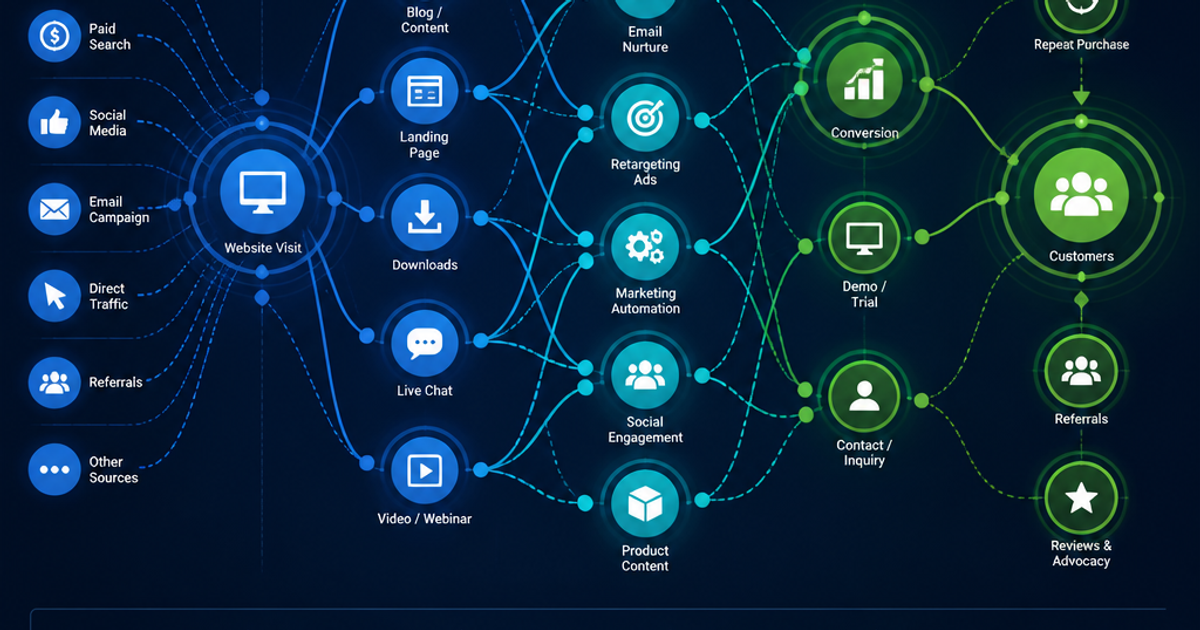
How does lead generation work step by step?
Lead generation via your website always follows the same logic, regardless of the sector. If you understand that logic, you can systematically optimize every step.
Step 1: Attracting the right visitors
Visitors arrive at your website via search engines, social media, or paid ads. For small and medium-sized enterprises, search engine optimization (SEO) is by far the most sustainable and cost-effective way to consistently attract new visitors. Paid ads can work faster, but stop the moment your budget stops.
The quality of traffic is more important than quantity. A thousand visitors who do not belong to your target audience yield less than a hundred visitors who are actively searching for what you offer. Every page you create should target a specific search term that your ideal customer uses.
Step 2: Turning interest into action
Once the visitor is on your site, the real work begins. Most visitors are in the orientation phase. They compare, read, and evaluate whether you can be trusted. Here, the combination of a strong value proposition, social proof, and a clear next step plays a decisive role.
A common mistake is directing all communication at the small minority ready to buy immediately. The smart approach also attracts orienting visitors by offering a low-barrier offer, such as a free consultation, a checklist, or a website scan. This way you build a relationship before someone becomes a customer.
Step 3: Collecting data via a form or action
A lead only becomes a lead the moment you have contact details. This happens via a form, a chat feature, or a direct click action to your phone number or email address. Keep the form as short as possible: name, email, and one relevant question are in most cases sufficient for initial contact.
Step 4: Follow-up and qualification
The best website in the world generates nothing if the follow-up isn't right. Automate the first confirmation email so that the lead gets immediate feedback after filling out a form. After that, human work begins: qualifying the lead, providing the right information, and making a concrete proposal at the right time.
A website that does not consistently generate new requests is not a marketing asset, but an expense. The question is not whether your website is pretty, but whether it works while you sleep.
Essential elements for generating leads online
Not every website element contributes equally to generating leads. Below you will find the elements that make the biggest difference in practice.
Clear value proposition above the fold
The value proposition is the sentence or headline that explains at a glance what you do, for whom, and what the visitor gets out of it. Someone who lands on your homepage decides within seconds whether to stay or leave. A vague slogan like "We are your partner for growth" is not enough. Be concrete: what does the visitor lose if they do nothing today?
Always place the value proposition visibly above the fold, so without scrolling. Everything important to convince the visitor should be immediately visible.
Social proof and trust signals
Social proof is one of the most powerful conversion factors on a lead generation website. Customer testimonials, case studies, logos of well-known clients, and reviews lower the barrier to contacting you. People trust the experiences of others more than advertising messages.
Place testimonials strategically, right before a form or CTA button. A testimonial describing a specific result works better than generic praise. "They doubled our customer base in six months" is more convincing than "Great collaboration."
One targeted call-to-action per page
Every page on your website should encourage one primary action. Too many buttons pointing in different directions cause confusion and lower the number of conversions. Decide per page what you want the visitor to do and consistently guide towards that. At Iconic Creative Agency, that conversation starts with a free strategy consultation, keeping the threshold for the first step as low as possible.
Tip: Use active, benefit-driven text on your CTA buttons. "Request free advice" works better than "Submit" or "Contact."

Lead magnets as a low-barrier entry point
A lead magnet is a free, valuable offer you give away in exchange for contact details. Think of a free website scan, a checklist, a mini-guide, or a free strategy session. Lead magnets are particularly effective for visitors who are not yet ready to request a quote directly.
The power lies in relevance. A lead magnet that addresses the exact problem your target audience struggles with converts significantly better than a generic e-book. For an agency building websites for entrepreneurs, a free website analysis is a strong example: it provides immediate value while demonstrating expertise.
Tip: Always link your lead magnet to an automated follow-up sequence via email. This builds trust with people still in the orientation phase, without having to manually invest time into it.
SEO as the foundation for acquiring customers digitally
Acquiring customers digitally is inextricably linked with search engine optimization for most businesses. SEO ensures that people actively searching for your service also find you. And that is precisely the difference with ads: a visitor via SEO searched themselves and is therefore further along in their buying process.
Every service deserves its own landing page
A common mistake among entrepreneurs is stuffing all services onto one page. In practice, a specific landing page per service or problem always converts better than a general services page. That applies both to SEO rankings and to conversion: a visitor searching for "have a logo designed in Belgium" who lands on a specific page about logo design is much closer to a conversion than someone landing on a generic page about "our services."
Furthermore, every landing page must be technically sound: load fast, be mobile-friendly, and display the most relevant information above the fold. A page that loads slowly loses visitors before the content is even visible, which directly harms conversion.
Content as the engine for sustainable traffic
Blogs, guides, and explanatory articles like this are not only good for SEO, they also help build trust. If you as an agency write an article about how lead generation via a website works, you immediately position yourself as an expert in that field. Visitors who land on your site through such an article are much warmer than visitors coming through an ad.
It is no coincidence that businesses that systematically produce content consistently generate more leads. Content works like a magnet that attracts the right people, even without actively advertising.
Comparison of lead generation strategies
Not every approach to generating leads online works equally well for every type of business. Below I compare three commonly used strategies across the most relevant factors for small and medium-sized enterprises.
Strategy · Costs and scalability · Speed of results and sustainability
SEO and content marketing — Low ongoing costs after initial investment in content and optimization. Scalable without proportional cost increases. — Results come slower, on average after three to six months. But positions once built generate free traffic for months without extra costs.
Paid ads (Google Ads / Meta) — Direct costs per click or per lead. Budget determines reach. Stops completely when the budget runs out. — Fast results possible right from the start. Not sustainable without an ongoing budget. Suitable as a temporary supplement to SEO.
Optimized website with lead magnets — One-time investment in design and tech, followed by low management costs. Works independently of advertising budget. — Immediately increases conversion from existing traffic. Combines well with both other strategies. Sustainable impact on your entire website.
The most effective approach combines all three: a strong website as the foundation, SEO for sustainable organic traffic, and targeted ads for quick boosts during busy periods. For entrepreneurs just starting to generate leads online, investing in a well-optimized website is the first and most profitable step.
Common mistakes in lead generation
After analyzing dozens of company websites, the same mistake patterns stand out time and again. If you recognize these, you'll immediately know where the quick wins are for your lead generation website.
No clear path after the first click
Many websites bring visitors to a homepage and then let them go. There is no logical follow-up path, no reason to stay, and no clear next step. In practice, the visitor then leaves the site without taking any action. The solution is a well-thought-out page structure where every page offers a next step.
Waiting too long to show proof
Entrepreneurs sometimes think customers want to understand services first before seeing testimonials. The opposite is true. Social proof should appear as early as possible on the page, preferably in the very first section. A potential customer who hesitates seeks confirmation that others had a positive experience, even before reading the details about your service.
Ignoring mobile visitors
A large portion of all website visits happens on a smartphone. A website that works well on desktop but is difficult to operate on mobile loses a significant portion of its potential leads. Check whether forms, buttons, and text work well on every screen size.
Failing to follow up on leads or following up too late
A lead filling out a form and subsequently hearing nothing for two days is a lost opportunity. The chance of conversion drops sharply as follow-up takes longer. Set up an automatic confirmation email sent immediately after every form submission, and ensure your personal follow-up happens within 24 hours.
For entrepreneurs who want to handle all of this themselves but don't know where to start, Iconic Creative Agency offers a free strategy consultation where we examine together what your website is currently missing and what the most immediate points of improvement are.
Frequently asked questions
What is the difference between an ordinary website and a lead generation website?
An ordinary company website is designed to show information: who you are, what you do, how you can be reached. A lead generation website is designed with one primary goal: converting visitors into identifiable contacts. Every element, from the headline to the button text, is aimed at generating a concrete action such as a form submission or a phone call.
How many visitors do I need to generate leads?
A realistic conversion rate for a well-optimized website is around one to three percent of total visitor numbers. So with a hundred visitors per month, you can expect one to three leads per month. If you want more leads, you either increase traffic via SEO or ads, or raise the conversion rate through better CTAs, social proof, and a stronger offer. Both tracks together yield the best result.
Which lead magnet works best for a service company?
For service companies, a free consultation, quick scan, or concrete analysis works best. A free website analysis, a free brand audit, or a free strategy session provides immediate value to the visitor while demonstrating your expertise. Avoid generic e-books that lack specificity: the more relevant the lead magnet to the visitor's problem, the higher the conversion.
Do I need to use paid ads to generate leads via my website?
No, paid ads are not a requirement. A well-optimized website combined with an SEO strategy can consistently generate leads without an advertising budget. Paid ads are useful as a supplement to an existing strategy, or to achieve quick results while your SEO is still building up. But as a foundation they are vulnerable: as soon as your budget stops, traffic stops.
How quickly do I see results from a lead generation website?
That depends on the strategy you choose. Improvements to existing pages, such as better CTAs, shorter forms, and social proof, can have a short-term effect on the conversion rate of existing traffic. SEO needs more time, on average a few months, before rankings and organic traffic grow. Paid ads deliver the fastest results but require an ongoing budget.
How do I know if my lead generation website is performing well?
The main metric is the conversion rate: what percentage of your visitors contacts you or makes a request? Use a tool like Google Analytics to track visitor behavior, see which pages they drop off on, and which channels bring in the most leads. A conversion rate of at least one percent is a realistic starting point. If your ratio is lower, your CTAs, trust signals, or the clarity of your offer are the first places to work on.
Do you already have experience generating leads through your website, and what made the biggest difference for you? Share it below, because other entrepreneurs learn a great deal from concrete practical experiences.
References
- Research into the profitability of online lead generation for businesses
- How lead generation on a website works and which conversion rates are realistic
- Lead magnets that work: from anonymous visitor to valuable contact
- How online lead generation works: components, channels, and KPIs
- SEO for lead generation: landing pages that convert