Only 14% of small Belgian businesses have a blog, and 24% of medium-sized ones. That means the vast majority of SMEs in Belgium let potential clients slip away every month to competitors who take the trouble to write valuable content. Content marketing for SMEs is not a luxury reserved for large budgets or marketing teams of ten. It is one of the few channels where your growing knowledge increases in value each month, rather than vanishing as soon as your budget stops. This article explains how you, as a Belgian SME, can build a content strategy that works.
Table of Contents
- Quick Insights
- What is content marketing for SMEs?
- Why blogging for businesses works
- Building a content strategy as an SME
- Choosing the right topics
- Comparison: three content approaches for SMEs
- Frequently Asked Questions
- References
Quick Insights
Key Insight · Explanation
SMEs perform better through niche expertise — Smaller teams can build authority in a niche faster through specific, in-depth knowledge than large, generic players.
Sales-focused communication cuts itself short — SMEs that only write about their product solely reach prospects in the final phase of the buying process. They miss the majority.
Content is a long-term investment — A well-written blog article still generates visitors months or years after publication, unlike a paid advertisement.
Consistency beats quality in the beginning — Publishing monthly with average quality delivers more results than one perfect blog post per year. Rhythm builds authority.
Content without a plan yields scattered results — Writing without a clear target audience or keyword strategy wastes time. Always start with a content strategy before writing your first word.
Internal links strengthen commercial pages — A blog cluster around a topic passes authority to your service or product page. That is the page that converts.
Content and advertisements are complementary — Ads deliver fast results, content provides sustainable growth. Together they are stronger than each on its own.
What is content marketing for SMEs?
Content marketing is an approach where you publish valuable, relevant information to attract, inform, and ultimately persuade a clearly defined audience. It is not about advertising. It is about being helpful to someone who has a question, is experiencing a problem, or wants to make a decision.
For a Belgian SME, this concretely means: write about what your customers type into Google in the evening. An accountant writes about VAT returns for the self-employed. A web design agency writes about what a good website should cost. A plumber writes about when it is best to replace a boiler. The knowledge you apply daily is valuable to your potential client.
The difference from traditional advertising is simple: with advertising, you interrupt someone. With content marketing, you are found at the moment someone is actively searching for an answer. That intent makes the difference.

Why blogging for businesses works
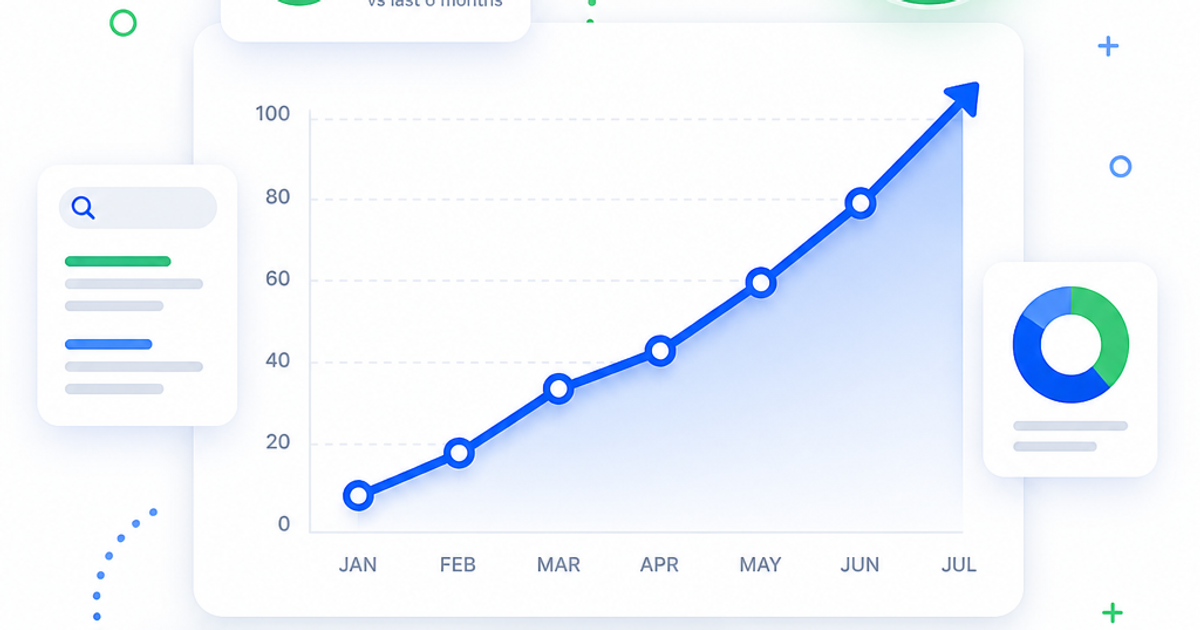
Blogging is the most accessible form of content marketing for SMEs, and at the same time the most underestimated. In Belgium, only 24% of medium-sized businesses have an active blog. In the Netherlands, that figure is already 40%. That difference is an opportunity, not a statistic to ignore.
Organic traffic that keeps growing
Those who publish systematically around a set of related keywords see organic traffic build up over time. A blog cluster around a specific theme also reinforces the authority of your commercial pages via internal links. Google recognizes that you are building topical authority and rewards the converting page—namely your service or quote page—with a higher ranking.
In practice, this means: write ten articles about a specific theme that concerns your clients, and link from each article to your main service page. That works better than ten disconnected articles about ten different topics.
Building trust before the first contact
A client who has read three of your blog articles before reaching out is a different client from someone who has only seen your homepage. They know your approach, recognize your expertise, and have already built trust. That trust lowers the threshold to make contact and increases the likelihood of conversion.
Content is the proof of expertise, not merely the claim of it. An SME that writes about the problems it solves on a daily basis proves its value in a way no banner ad could ever match.
Tip: Write your first ten blog articles about the ten most frequently asked questions you receive from clients. You already have the answers in your head. All you need to do is write them down in a way that is also understandable to outsiders.
Building a content strategy as an SME
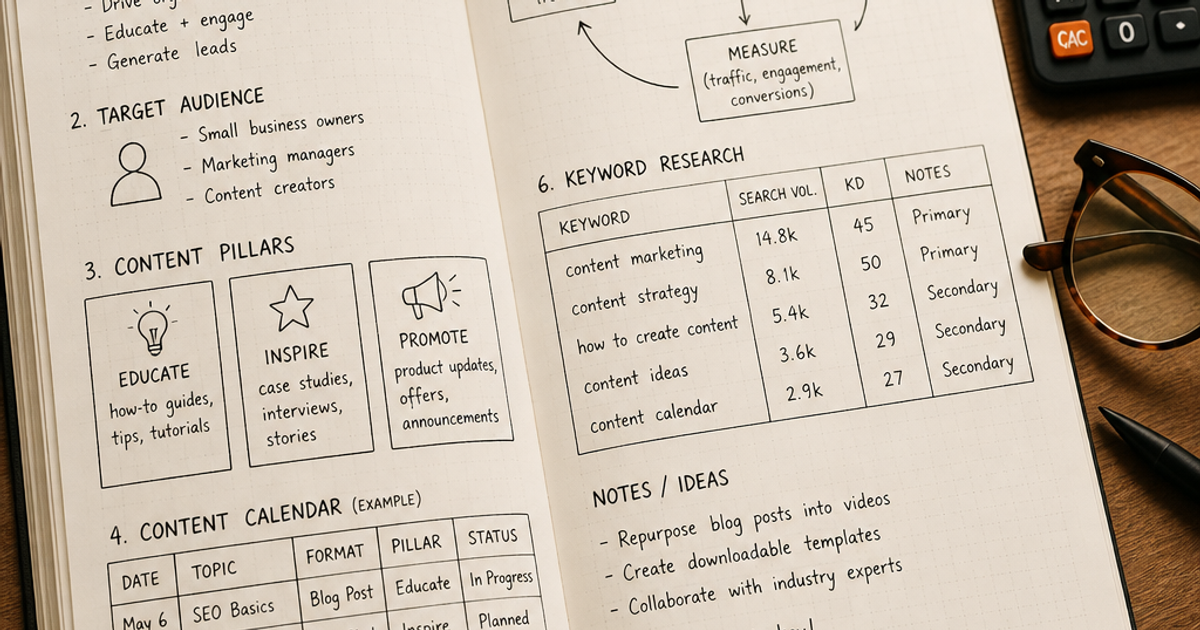
A content strategy for an SME does not need to be a twenty-page document. But writing without a plan yields scattered results that are difficult to measure and rarely lead to growth. A workable strategy consists of three components: target audience, keywords, and publishing cadence.
Step 1: Determine who you are writing for
This sounds obvious, but most SMEs skip this step. Are you writing for the owner of a small business who does everything themselves? Or for the marketing manager of a medium-sized enterprise? Those two individuals have different questions, different language, and different decision criteria. An article that tries to work for both works well for neither.
Create a persona of your ideal reader: their job title, the challenges they face daily, and the questions they ask on Google. Check everything you write against that description.
Step 2: Choose keywords that are realistic
A common mistake among SMEs: targeting keywords with tens of thousands of monthly searches. The competition for those terms is overwhelming. Start with more specific, longer keywords, also known as long-tail keywords. "Web design agency Ghent" is more realistic than "web design". "Accountant for self-employed Antwerp" is more realistic than "accountant".
Free tools like Google Search Console, Google Trends, or the search suggestions at the bottom of a Google results page give you a good starting point. Paid tools like Ahrefs or Semrush offer more detail, but are not necessary for most SMEs in the beginning.
Step 3: A publishing cadence you can maintain
Consistency beats perfection. One blog article per month that you maintain consistently delivers more than a sprint of five articles followed by a three-month hiatus. Google and your readers appreciate regularity. Set a realistic cadence, and stick to it.
Tip: Plan your content thematically per quarter. In the first quarter, write four articles that each answer a different question around the same theme. That way you build topical authority faster than with four disconnected topics.
Choosing the right topics
The biggest stumbling block for SMEs is not the writing itself. It is figuring out what to write about. A practical method: divide the buyer journey into three phases and write at least two articles per quarter for each phase.
Awareness stage: identifying problems
In this stage, the reader does not even know you exist yet. He or she has a problem and is looking for information. Write about the symptoms your clients describe before contacting you. "Why am I losing visitors on my website?" or "How much does a new website cost for a small business?" are typical search queries from this stage.
Many SMEs skip this stage entirely and only write about their services. That is a mistake. Those who only publish sales-focused content only reach the small group of prospects who are already almost certain of their decision. You will never reach the rest—the majority of your potential clients—this way.
Consideration and decision stage: comparing and persuading
As a reader gets closer to a decision, their search queries become more specific. "Difference between a freelance web designer and an agency", "content marketing or social media ads: what works better for SMEs?", or "what is a fair price for logo design?" are typical search queries from the consideration and decision stage.
Case studies are particularly effective in the decision stage. A concrete example of how you solved a similar problem for a client answers the question "can this agency work for me too?" better than any generic promise on a service page. At Iconic Creative Agency, we see this pattern with virtually every new client: they had already read content or viewed a case study multiple times before requesting a free strategy call.
Comparison: three content approaches for SMEs
Not every content approach fits every SME. The choice depends on your available time, budget, and the speed at which you want to see results. Below is an honest comparison of three common approaches.
Approach · Advantages · Disadvantages
Writing yourself — Authentic, low cost, deep professional knowledge on display — Time-intensive, difficult to sustain consistently alongside daily workload
Outsourcing to an agency — Professional results, consistent cadence, SEO optimized — Higher cost, requires solid briefing and knowledge transfer about your industry
Hybrid approach — Combines your domain expertise with professional writing quality and strategy — Requires good coordination and regular consultation
For most SMEs, the hybrid approach is the most realistic in the long term. You provide the expertise and direction; a partner like Iconic Creative Agency takes care of the strategy, copywriting, and SEO optimization. This keeps the content authentic and technically accurate without requiring you to free up hours every week to sit behind a screen.
A common mistake when outsourcing: hiring an agency that only delivers automated, AI-generated content without quality control. Mass-produced content without editorial quality control demonstrably performs worse, both for Google and for readers, than thoughtfully written copy.
Frequently asked questions
How quickly will I see results from content marketing as an SME?
Content marketing is not a channel for those expecting results within a few weeks. Count on six to twelve months before organic traffic increases noticeably. Those who publish consistently around a keyword cluster often see a clear acceleration between months six and twelve. Paid advertising is better suited for short-term results. The strongest approach combines both.
How many blog articles should an SME publish per month?
One high-quality article per month is already a solid start. Two per month is realistic for most SMEs that outsource or use a hybrid approach. More is better, but only if quality does not drop. A poorly written article does not help you. It harms your reputation with readers and gives Google little reason to rank you higher.
As an SME, do I also need to be present on social media alongside my blog?
Social media and blogging are complementary, not competing. Six out of ten Belgian SMEs are active on social media. A blog provides evergreen content found via search engines. Social media provides short-term reach. Use your blog posts as the basis for social media posts, so you do not have to feed each channel separately with new ideas.
What is the difference between a content plan and a content strategy?
A content strategy encompasses your target audience, goals, positioning, and the themes around which you want to build authority. A content plan is the operational schedule: which article you publish when, for which keyword, and for which stage of the buyer journey. You need both. A plan without a strategy yields arbitrary content. A strategy without a plan remains an abstract intention.
Can I do content marketing as an SME on a small budget?
Yes, but with a realistic view of what is achievable. Writing yourself costs no money, only time. The biggest risk with a small budget is not the lack of money, but the lack of consistency. Quitting after three months because it gets too busy means getting very little out of the texts already published. Consider a small external budget for strategy and planning, even if you write the copy yourself.
Which types of content work best for Belgian SMEs?
Practical guides, answers to frequently asked questions, and comparison articles score well for SEO and build trust with readers. Case studies work exceptionally well in the decision stage of the buyer journey. Stick to written formats: they are more durable, easier for Google to index, and do not require a production crew for video and audio.
How do I know if my content marketing is working?
Track three indicators: organic search traffic to your website via Google Search Console, the number of contact inquiries referencing content someone read, and the rankings of your target keywords in Google. Draw up a brief monthly report, even if it only takes five minutes. If you do not measure, you will not know what to adjust.
Do you already have experience with content marketing as an SME, or are you running into a specific challenge when setting up your content strategy? Let us know in a comment, as concrete questions help improve this article further.
References
- Research into content marketing among Belgian SMEs based on Eurostat data
- Practical guide on content marketing for SMEs and the ROI of blog posts
- Overview of content marketing as a long-term investment for growing SMEs in Flanders
- Seven tips for successful content marketing specifically for SMEs
- Twelve practical content marketing tips for SMEs resulting in more leads